



Asthma is a common problem that affects 7% of the population. The number of people diagnosed with asthma and actually dying from asthma has steadily increased over the past 15 years. It is a disease characterized by obstruction and inflammation of the airways in the lungs, which may cause shortness of breath and wheezing — a whistling sound produced as air flows through narrowed air passages. This airway obstruction is usually reversible (either by itself or with treatment), but recurrent.
Asthma attacks can vary in intensity. Many can be mild and the individual may experience only chest tightness or a cough. Other episodes may be quite severe and require emergency treatment or hospitalization. Asthma is not usually a fatal disease, but for many it may be an extremely troublesome problem that affects daily activities and alters desired lifestyles. Untreated, it is a frequent cause of school and work loss and may lead to emergency room visits or hospital stays.
What Causes Asthma?
No one knows why some people get asthma and others do not, but hereditary factors do play a role. People with asthma usually have "triggers" which make them wheeze. Common triggers include inhalant allergy (pollens, mold spores, animal danders, dust), food allergy, colds or respiratory infections, exercise, irritants such as tobacco smoke, sudden temperature or barometric pressure changes, fatigue, stress, cold temperatures, gastroesophageal reflux, and hormonal changes. It is very important for people with asthma to know what their triggers are, because this can help them control their disease.
What Happens During an Asthma Attack?
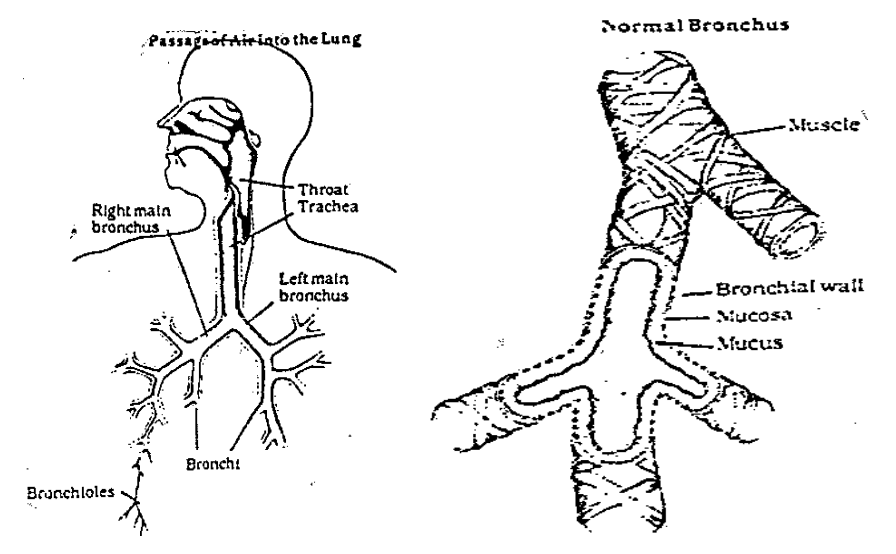
In order to understand what happens during an asthma attack, you must have some idea of the anatomy of the lungs. The lungs can be thought of as a series of tubes or branches which get smaller and smaller (like a tree). The largest tube — the windpipe, or trachea — divides into smaller tubes called bronchi. These bronchi divide into smaller tubes called bronchioles. The very small tubes (bronchioles) end in tiny air sacs, and this is where oxygen and carbon dioxide are exchanged.
On the outside of all the lung tubes are bands of muscles which circle around the tubes. We cannot control these muscles of our own free will, just like we cannot control the muscles that make us cough or sneeze.
On the inside of all the lung tubes is a moist lining called the respiratory mucosa (or mucus membranes). Cells in this lining produce thin watery mucus that lubricates the tubes. This mucus is constantly being pushed upward toward the throat by tiny hairs (called cilia) that beat in a constant waving motion.
When a person is having an asthma attack, three main things are happening to the airways. First, the bands of muscles around the bronchial tubes constrict and tighten (spasm). Second, the mucus membrane lining the inside of the bronchial tubes swells and becomes smaller. Third, the mucus membrane begins to produce increased amounts of mucus, which also becomes thicker and does not move as easily. The combination of muscles tightening around the outside of the tubes plus swelling and increased mucus on the inside narrows the airways and makes breathing more difficult. At first, the person may just notice chest tightness or a cough. As the airway continues to decrease in size, the person starts to wheeze as air is pushed through the narrowed bronchial tubes.
What Usually Happens With Asthma?
The course that asthma takes depends on many factors — such as how old the person was when the asthma began, how severe their asthma is, how allergic they are, and whether there are other allergic problems alongside the asthma. Some people who have asthma as children will outgrow it, but others will have it all their lives. About 50% of adults with asthma began wheezing when they were children.
What Problems May Occur?
Many people with severe asthma suffer with many days of wheezing, have frequent infections, must miss work or school often, have poor appetites, and do not sleep well. If asthma is severe and prolonged, and if it occurs at a very young age, it may lead to stunted growth. Frequent infections can leave scars on the lungs which cause permanent damage. A few patients may become disabled from permanent changes in the lungs that prevent some of their normal daily activities.
What Can I Do to Help Myself Get Better?
The most important thing you can do, if possible, is to learn what things trigger your asthma and then avoid those things.
There are other ways to help prevent attacks or make attacks less severe when they do occur. If you notice asthma symptoms, you should limit your activity. If the symptoms continue, take medications as directed. If increased symptoms do not respond to medication, call your doctor.
Call Your Doctor If These Conditions Occur
- Severe asthma symptoms
- Waking at night because of shortness of breath
- Overusing your inhaler (more often than every 4 hours)
- Asthma symptoms lasting longer than 24 hours
- Immediately if peak flow is in the red zone, or in the yellow zone longer than 24 hours
- Change in color of mucus — from clear or white to discolored (yellow or green)
What Happens When Asthma Is Treated?
Asthma treatment starts by forming a partnership with you and your asthma doctor. Routine checkups are recommended several times each year. This allows you and your doctor to review how you have been feeling, your medications, symptoms, and peak flow readings. Your doctor may be able to decrease your medication if you are doing well, or it may be necessary to "step up" your medications if you are having problems. It also gives you a chance to review asthma triggers and develop plans to follow should you have an asthma attack.
The best way to treat allergic asthma is with allergy treatment, which combines many types of therapy — including avoiding allergens, proper medical care with inhaled and oral medications, and when needed, allergy shots. As many as 80% to 90% of children with allergic asthma will get complete or near-complete relief after several years of allergy treatment. With proper care, almost all persons with asthma can live a normal life.
The goals of treatment are for patients to be symptom-free, to lead a normal lifestyle, not to miss work or school because of asthma, to have good exercise tolerance, normal or near-normal breathing test and peak flow readings, and to have the least amount of side effects from medications.
Children obtain a complete recovery from asthma more often than adults. Adults can expect a large decrease in both the number and severity of attacks. When children receive proper care, they can be saved from many years of asthma attacks, wheezing, infections, and missed school. Even with the best care, a small number of children and adults will continue to have severe asthma that is very hard to control.
Additional Resources
We encourage you to seek more information about your asthma. Please contact our office staff regarding materials we have available. The following external resources are also available:
-
Organizations
Asthma and Allergy Foundation of America
8201 Corporate Drive, Suite 1000, Landover, MD 20785
Phone: 1-800-727-8462
Website: www.aafa.orgAllergy & Asthma Network / Mothers of Asthmatics
8201 Greensboro Drive, Suite 300, McLean, VA 22102
Phone: 1-800-878-4403
Website: www.aanma.org -
Information Lines
American College of Allergy, Asthma, and Immunology: 1-800-427-7777 | www.acaai.org
American Academy of Allergy, Asthma, and Immunology: 1-800-822-2672 | www.aaaai.org
Local Chapter of the American Lung Association: 1-800-586-4872 | www.lungusa.org
-
Recommended Books
Children With Asthma: A Manual for Parents — T. Plaut, M.D.
Asthma: The Complete Self-Management Guide to Asthma and Allergies for Patients and Their Families — Allan Weinstein, M.D.
A Parent's Guide to Asthma — Nancy Sander
These books can be ordered through your local bookstore or through the Asthma and Allergy Foundation of America.
-
Asthma Camp — Camp Superkids
Our office helps support Asthma Camp, sponsored by the American Lung Association. Contact our office for more information.
If you have any questions, contact our office: Omaha: 402-391-1800 Lincoln: 402-464-5969
Call to Schedule an Appointment!
Lincoln: 402.464.5969 Omaha: 402.391.1800